Blog Post
Digital Solutions, Analog Delivery: The Hidden Failure Point in Healthcare
When I talk to CEOs, I always start with the same question: Do you know how much you are spending on healthcare? The universal answer is “Too Much”.
Justin Holland
·
·
8 min read
When I talk to CEOs, I always start with the same question: Do you know how much you are spending on healthcare? The universal answer is “Too Much”.
The reality is, very few know the actual number, and I can name the CEOs on one hand that can explain the inputs driving it. Consider this: If a CEO couldn't explain why their supply chain costs spiked 20% or why their cloud computing bill doubled, there would be an immediate internal audit. Yet, for decades, we’ve accepted this opacity as "business as usual" in healthcare. We accept rising premiums and confusing claims data as if they are weather patterns we cannot control.
For most organizations, healthcare and benefits represent the top-two organizational spend, yet, unlike every other department, it runs on a strategy that cannot perform.
The Experience and Engagement Gap
Carriers were supposed to drive better outcomes, but they didn’t. As a trusted advisor, you’ve meticulously architected robust benefits strategies for your clients. You’ve curated the best point solutions from telemedicine to chronic care to mental health, fertility and beyond. You’ve negotiated the contracts and validated the investment.
Yet, every year you face the same disappointing reality:
A fragmented experience: While employees demand an intuitive, consumer-grade “shopping experience” with real time answers, the market has responded by adding disparate vendors and confusing apps, making employees overwhelmed by a complex ecosystem
Low engagement: Great benefits go unused because no one knows how or where to access them
The “Groundhog Day” of renewals: Despite all the effort, you’re still fighting defensive battles over rising premiums, leading to an endless cycle of cutting and replacing programs
Zero control: A system that operates on inertia rather than strategy
The Delivery Gap: Managing Modern Complexity with Old Tools
The truth is, your strategy isn’t broken; the individual solutions work in their own silos. The failure lies in how those solutions are delivered. We are attempting to manage a hyper-complex, 21st-century ecosystem using a strategy frozen in 1978.
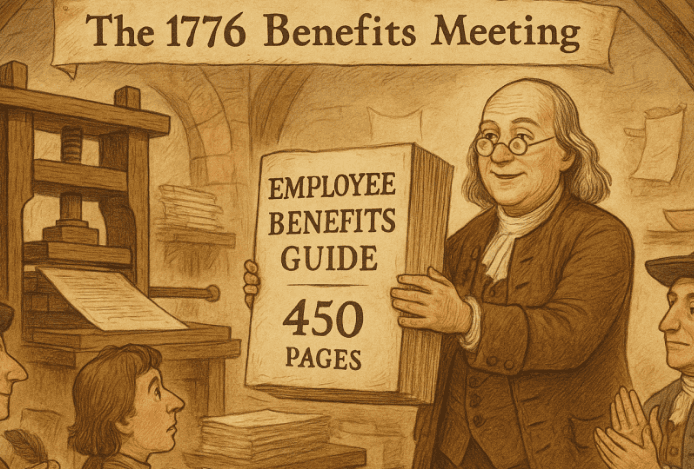
That was the year the Revenue Act created section 125 “Cafeteria Plans”, which introduced the concept of the annual open enrollment election period. At the time, open enrollment was a literal, physical event. Employees gathered in a cafeteria to listen to a presentation and pick up a packet. That manual delivery method worked because benefits were simple. Today, we’ve kept that exact delivery method of paper guides and packets while the complexity of benefits has exploded.
We dump information on employees once a year and hope they remember it, but expecting your employees to navigate a maze of 20+ digital solutions using a mental map formed during an hour lecture is not a strategy, it’s the punchline of a Dilbert cartoon. You’re missing the critical piece of the puzzle required to integrate them.
The Last Analog Department
For years, businesses have invested in sophisticated operating systems to ensure efficiency and maximum ROI across every major department. Look at the rest of the enterprise:
Finance runs on NetSuite
Sales runs on Salesforce
HR runs on Workday
Engineering runs on Atlassian
Every critical part of operations has a centralized source of truth: software that aggregates data and streamlines workflow. But, healthcare still runs on PDFs, spreadsheets, and blind faith.
With that understanding, ask yourself: Where is the operating system for your healthcare spend?
Employer sponsored benefits desperately need a Benefits Operating System. We need a foundation that unifies vendors, data, and communication into one intelligent platform that brokers and employers can truly steer rather than just react to.
That’s what we’ve been building at HealthJoy for the past decade.
From The Duct-Tape Years to the AI Era
Like every early innovator, we had to use a little duct tape to make the impossible possible in the early days. We combined people, data, and emerging models to deliver an experience that technology alone couldn’t yet support. That human-plus-AI fusion became our secret advantage.
But now, the technology has finally caught up to the vision we’ve had from the start. Generative AI allows us to automate complex triage, personalize guidance based on specific plan designs, and finally simplify the benefits experience the way we’ve always imagined. We aren’t just answering questions, we’re anticipating needs and finally moving from a reactive to a proactive model. A true benefits operating system does three things:
Guides members with AI-driven intelligence: Employees need more than information, they need guidance. We steer members to the most relevant benefits at the moment of need.
Unifies the experience: When the entire ecosystem is synthesized into one platform, you can ensure the benefits strategy you designed is the one employees actually experience.
Drives cost containment: A good strategy is useless if no one uses it. The OS proactively steers members toward high-value, low-cost care.
Performance as Designed: The ROI
When your benefits strategy has an OS, you stop playing defense and drive massive shifts in employee behavior.
For instance, consider a member with chronic knee pain. Without an OS, they might go straight to an expensive specialist or surgery. With our OS, we know that 80% of members take a recommendation for a better, lower-cost path. In one case, a member was steered to the right care, resulting in $22,963 in employer savings while the member paid $0 out-of-pocket.
The Partnership Imperative
Here’s the truth: this technology only works with strong partnership.
If you’re a broker who just wants another vendor in your stack, we’re probably not the right fit. We aren’t a plug-and-play for a passive strategy.
But, if you’re the kind of consultant who wants to transform cost containment, engage members at scale, and bring real transparency to your clients—then the Benefits Operating System is built for you. The magic happens when the broker, the employer, and HealthJoy work as one team.
The Employer sets the strategic goals
The Broker architects the plan and manages the risk
HealthJoy provides the OS to execute that strategy and measure results
That’s where we’ve seen the most significant cost savings, the highest engagement, and the happiest members. And that’s exactly how we plan to build for the next decade—with the most innovative partners in the business.
A New Era for Benefits
For the first time, the technology exists to deliver on what everyone in this industry has been promising for years. AI is no longer theoretical—it’s operational. The Benefits Operating System gives brokers and employers something they’ve never truly had before: Control, insight, and a system that learns and adapts to deliver measurable outcomes.
If every other department runs on best-in-class operating systems, shouldn't employee benefits—one of your top two expenses—do the same?
We’re building the foundation for the next generation of benefits. Let’s build it together. Reach out to a HealthJoy expert to find out more today.

Blog Post
AI in Benefits 101: One Year Later — What It Actually Takes for Employees to Trust AI with Their Benefits

Blog Post
AI Can Be Responsible for the Outcome. It Can't Be Accountable for It.
When AI handles the routine, humans get to work on what matters most. Not less work, more meaningful work. The benefits experience is full of moments that are genuinely high-stakes, deeply personal, and impossible to reduce to a transaction. Those moments don't disappear when AI arrives. They become the work.